The Green Cabinet Down the Lane: A Five-Minute Defib Walk That Pays You Back in Calm
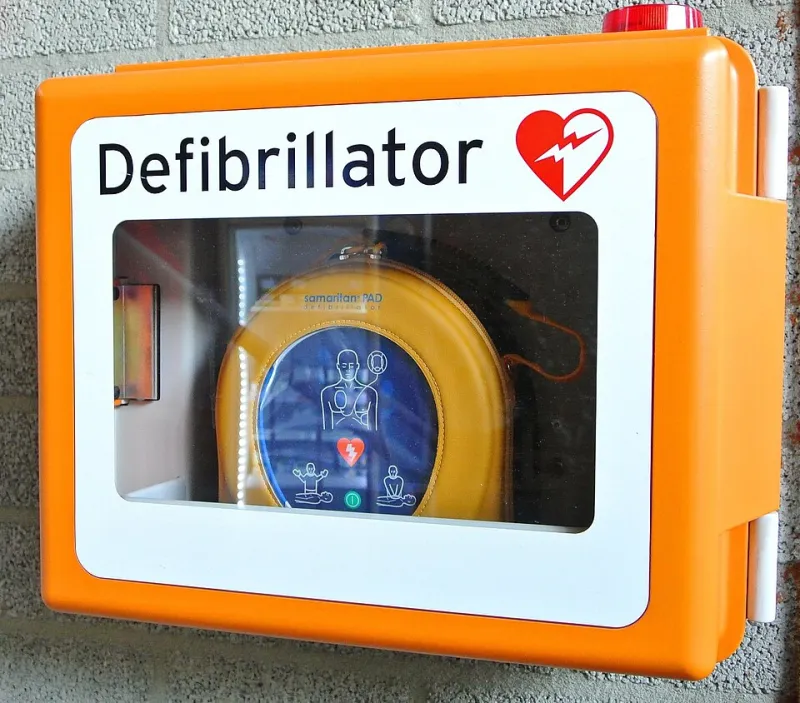
Photo: Tanja-Denise Schantz, CC0, via Wikimedia Commons
Most of us know where the nearest fire exit is at work, or which cupboard holds the spare loo roll. Yet ask a room of perfectly capable adults where their nearest public defibrillator lives and you will often get a shrug. That is not a failure of caring. It is just one of those small, practical unknowns we never get round to sorting.
A public access defibrillator — often called a PAD, or just a defib — is a sturdy little box with a very specific job. It can help restart the heart when someone has a cardiac arrest. You do not need to be medically trained to use one. You do not need to be fearless. You mostly need to know where it is, and to be willing to make one short walk this week to check.
Why a defib recce is a heart habit, not a horror story
It can feel morbid to go looking for emergency equipment. But knowing your local cabinet is less about expecting the worst and more about clearing a mental hurdle. In a real emergency, small unknowns become big delays. Which door is it behind? Is the village hall open? Is that the sports club cabinet or the one by the library?
A five-minute walk to your nearest defibrillator is a bit like noticing where the life rings are on a river walk. You hope you never need them. You are still glad they are there, and gladder still that you know where to point.
This is calm prep. It is also a very British sort of errand: a short stroll, a bit of local curiosity, and a quiet word with someone at the village hall.
Find your nearest: start with a map, not a panic
In the UK, you can usually find registered public access defibrillators through online defib maps, including Defib Finder. Your local ambulance service may also have information, and many communities list their cabinet on parish council or sports club pages. If you are not sure where to start, ask at the library, the leisure centre or the corner shop. Someone will often know the green box on the wall.
In an emergency, always call 999 first. The call handler can tell you where the nearest defibrillator is and how to access it. That is the key point: you do not have to memorise everything. You just need a rough idea of your local patch.
For your recce, pick a dry afternoon and walk the route you would actually take. Note the landmark — the bus stop, the church gate, the yellow bin store — rather than just the postcode. If the cabinet is inside a building, check the opening hours from the outside. If it is on an outside wall, note whether it looks reachable at night.
What the cabinet code actually means
Many cabinets have a keypad. The code is there to open the cabinet, not to operate the defibrillator itself. In an emergency, the ambulance service can give you the code when you call 999. Some cabinets are unlocked, and some are held by a venue that can hand over the code during opening hours.
It is worth knowing this before you need it, because a keypad can look like a barrier when you are flustered. It is not. It is just one more step, and one that 999 can talk you through.
Do not publish cabinet codes online, and do not stick them to the front of the box. The point of the code is to keep the equipment secure while making sure it is available when someone calls for help.
The pads are not a test you can fail
Inside the cabinet you will usually find the defibrillator and a set of pads. The pads are sticky, single-use and designed for people who have never done this before. The machine gives voice prompts. It tells you where to put the pads, usually with pictures on the pads themselves. It analyses the heart rhythm and decides whether a shock is needed.
You cannot make it shock someone who does not need it. You cannot easily break it. If the chest is hairy, the pads may need a firm press to stick properly, but the machine will guide you. The important thing is to follow the prompts and not delay while worrying about doing it perfectly.
If you are ever in that situation: call 999, put the phone on speaker, start CPR if you can, and send someone for the defib. The machine is a helper, not a replacement for the ambulance crew on the other end of the line.
Your five-minute local audit
Here is a simple version you can do this week, without opening anything or testing any equipment.
- Pick your nearest cabinet from a defib map or local knowledge.
- Walk there and note the exact spot and a landmark.
- Check access from the outside: is it on a 24-hour wall, or inside a building with opening hours?
- Look for signage. Is the cabinet easy to spot from the road?
- Note whether there is another cabinet on your route, in case one is inside a locked building.
- Save the location in your phone maps or notes, and tell one other person.
- If the cabinet looks damaged or missing, tell the venue or your local ambulance trust. Do not try to fix it yourself.
That is it. No heroics. No medical quiz. Just one small piece of local knowledge moved from the back of your mind to the front.
Make it a community thing
A defib recce is even better with a neighbour or a friend. You can compare notes, check the route at different times of day, and make sure the information does not live with just one person. At a village hall, sports club or community centre, it is a reasonable question to ask: where is our cabinet, and who holds the code?
You do not need to turn it into a campaign. A quiet pin on the family WhatsApp, a note in the parish newsletter, or a quick word with the person who runs the Saturday café can all help. Community heart health is often built from exactly this kind of ordinary, unglamorous detail.
At H4RT, we are fond of habits that fit into real life. A five-minute walk to the green cabinet down the lane is not a grand gesture. It is a small, sensible one — and it pays you back in calm. Know your box. Know your route. Then get on with your day.