The Wrist Is a Prompt, Not a Prognosis: A Calm Guide to Smartwatch Heart Data
It is 7:12 on a grey Tuesday morning and your watch has just buzzed against your wrist. The message says something about an irregular rhythm. You have not finished your tea yet. Your first thought is probably not a calm one.
That little buzz is one of the most common ways heart health now arrives in British homes: through a gadget. And that is not a bad thing. A smartwatch can be a useful nudge, especially if you are the sort of person who ignores a twinge until someone else mentions it. But it is worth being clear about what the thing on your wrist is actually doing, and what it is not.
What your wrist is really measuring
Most consumer wearables use light sensors on the back of the watch to estimate blood flow at the skin. Some also let you press a finger to the case to record a single-lead ECG. Others count steps with movement sensors, estimate sleep from a mix of movement and heart rate, and turn all of that into scores that look very official.
They are clever. They are not clinical-grade monitors. A watch is not a cardiologist, and a single reading is not a diagnosis. It is a prompt: something worth checking, perhaps worth mentioning, but not something to build a whole self-diagnosis around before breakfast.
The rhythm gap: a notification is not a finding
Irregular rhythm notifications can be genuinely useful. They have helped some people notice atrial fibrillation, a common heart rhythm condition that often has no obvious symptoms. That matters, because AF raises the risk of stroke and is worth treating when found.
But the technology has limits. It can miss rhythms that come and go. It can flag things that turn out to be harmless. It can be thrown by movement, a poor contact with the skin, or a perfectly normal variation in your heartbeat. A watch ECG is a single-lead tracing recorded in less-than-perfect conditions. It is not a 12-lead ECG in a hospital, and it is not a diagnosis.
If your watch flags something, the sensible response is not to record again and again until you get a reading you prefer. Note how you felt at the time, export the reading if your device lets you, and book a conversation with your GP surgery. If you have chest pain, severe breathlessness, fainting or feel very unwell, do not wait for a watch to tell you what to do. Call 999.
The pressure gap: your wrist cannot cuff an artery
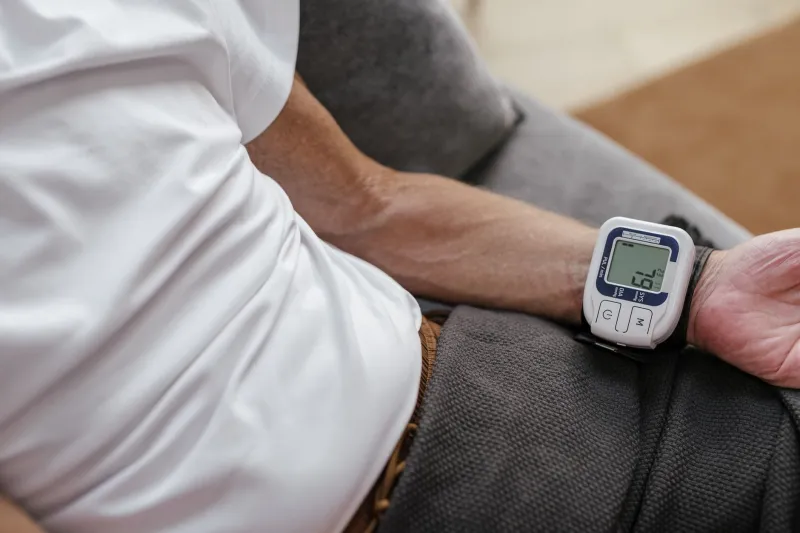
This is the gap most people underestimate. Heart rhythm is only one part of the picture. Blood pressure matters enormously, and consumer watches are generally not a reliable way to measure it. A cuff that squeezes your upper arm is still the standard for a reason.
If you are aged 40 or over in England, you can walk into many community pharmacies and ask about the NHS Pharmacy Blood Pressure Check Service. It is free, quick, and done by someone who does it often. Availability varies across the UK, so it is worth checking with your local pharmacy or GP surgery. If you have a family history of high blood pressure, kidney disease or early heart disease, ask earlier rather than later.
Do not use your watch as a reason to skip a proper check, and do not use it as a reason to panic either. If a home reading matters, use a validated upper-arm monitor and bring the numbers to your GP. One high reading is not a diagnosis. A pattern over time, taken calmly, is much more useful.
The sleep and steps gap
Sleep scores feel scientific because they have decimal points and colours. In reality, they are estimates based on movement and heart rate, and different brands score the same night differently. If you wake up feeling rested, that is data too. If you wake up exhausted for weeks, that is worth a GP conversation whether your watch gives you a gold star or not.
Step counts are similar. Ten thousand steps is a marketing number more than a medical threshold. Research generally points towards benefits from getting moving, with diminishing returns as you go higher. Somewhere around 7,000 to 8,000 steps a day is a reasonable aim for many people, but a walk to the post office still counts. Your watch does not know that you stopped to chat to a neighbour, and that matters for your heart in ways a step count cannot capture.
When the data becomes the problem
There is a real phenomenon of people becoming more anxious, not less, because of constant heart data. Checking your heart rate every few minutes, comparing your sleep score to your partner's, or lying awake worrying about your resting heart rate is not prevention. It is another source of stress, and stress is not great for the heart either.
A few practical boundaries help. Turn off constant heart-rate display if you find yourself glancing too often. Keep notifications on only for the things you have decided to act on. Review your data weekly rather than hourly. Remember that your watch has no idea whether you are nervous, caffeinated, dehydrated, or simply sitting on a crowded train.
A sensible 2026 routine
Use the watch as a nudge, not a referee. If it flags a rhythm, book a GP appointment and take the information with you. If you are over 40, ask about a pharmacy blood pressure check. If you have symptoms, trust the symptoms over the gadget. And if you are worried, say so out loud to a real person rather than scrolling through forums at midnight.
The wrist can tell you something is worth a look. It cannot tell you what your heart means. That part still belongs to you, your GP, and the people who know you best.